
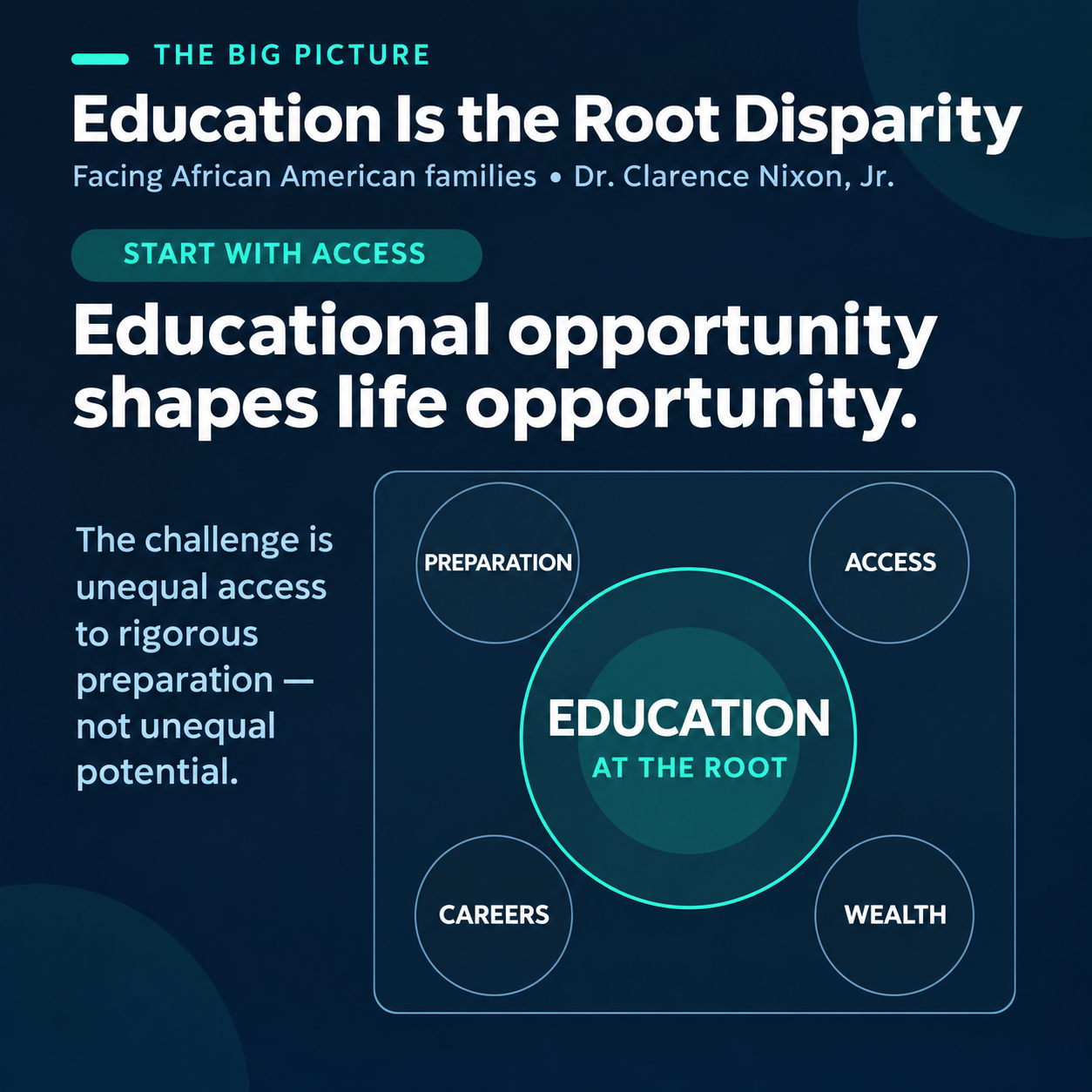
Every disparity has a starting point. For African American families, that starting point is the classroom.
We talk often about the racial wealth gap, gaps in health, and gaps in who goes to prison.
Those gaps are real and urgent. But when we trace them back, most lead to the same place: unequal access to rigorous, high-quality education. Educational disparities are the root disparity for African Americans. They shape income, innovation, health, and opportunity for decades, and they follow our children from the first ACT to the last professional licensing exam.
In this post, we walk through the evidence:
• What the 2025 ACT and SAT results reveal about preparation and access
• How test scores and family income feed each other
• How the gap follows students into graduate and professional school, using 2024 GMAT, LSAT, and MCAT data
• How patent data exposes our "Lost Einsteins"
• How education drives wealth and incarceration gaps
• What parents, grandparents, and students can do right now
Education First, or Risk Becoming a Slave, Servant, or Consumer
Bishop B.A. Gibert put the stakes plainly. This is not about grades. It is about destiny.
In his message Educating Our Children in the 21st Century, delivered on the inaugural t.Lab Global TV and Radio podcast, Bishop Gibert warned that children left to society's default systems will be trained for only three roles: a slave, a servant, or a consumer.
A substandard education produces a stunted intellect. It prepares a child to follow orders, serve someone else's vision, and spend money on someone else's products. It does not prepare that child to lead, build, or own.
He also named the economic reality we now face. In a global economy, the world no longer pays undeveloped talent above a sustenance level. Gifts that are never trained become gifts that are never rewarded.
Bishop Gibert's answer is clear: education first. Parents must be intimately involved, directional, exemplary, and diligent. Every responsibility to educate a child comes with grace to succeed. The data below shows exactly why that call is urgent.

Why Education Is the Upstream Disparity
Fix the source, and the river runs clean.
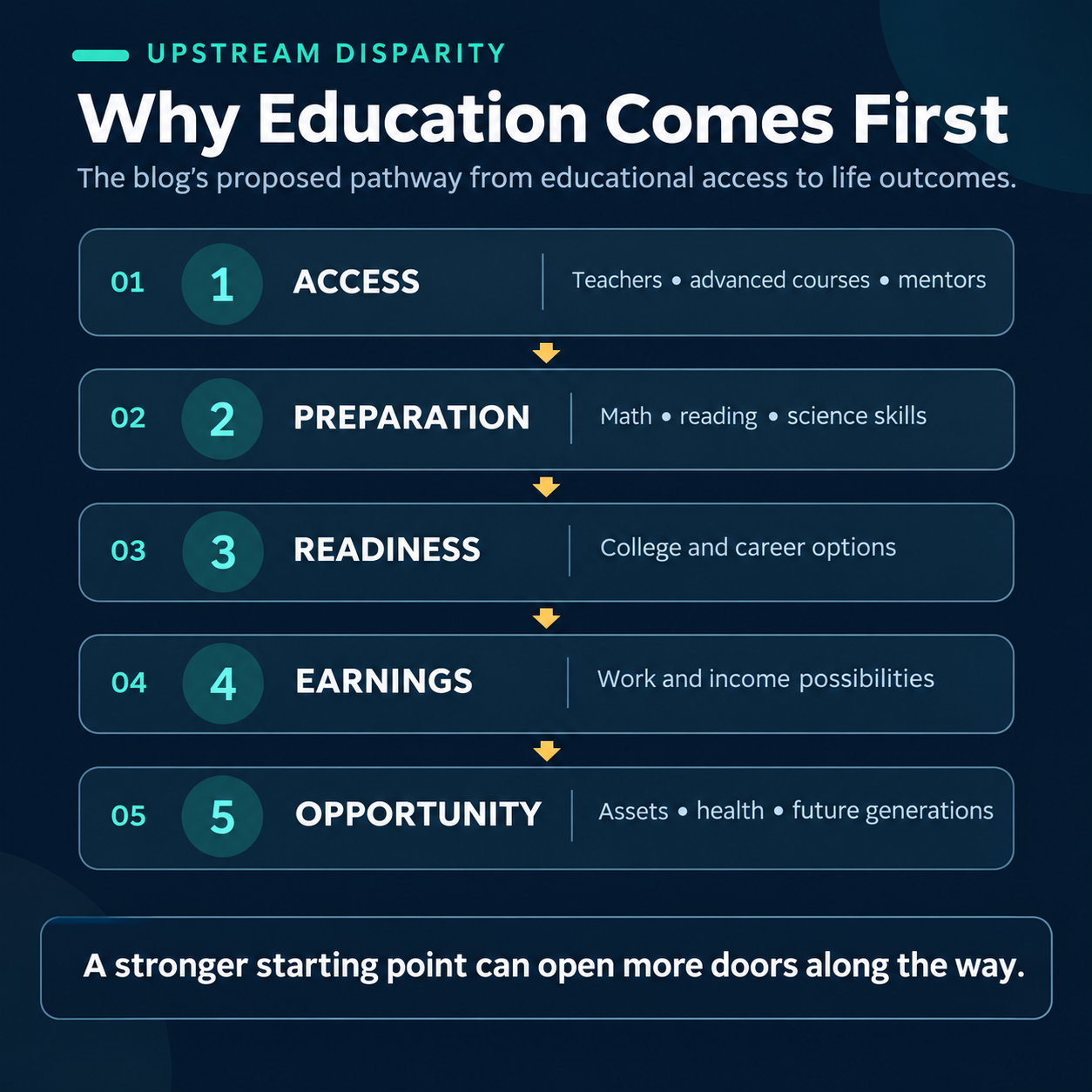
Education sits upstream of nearly every outcome we care about.
A child's schooling shapes the jobs open to them, the income they earn, the neighborhood they can afford, and the health care they receive. Each later gap draws power from the first one. When a student enters adulthood without strong math, reading, and science skills, every other door gets heavier to open.
This is not a debate about talent. Our children carry extraordinary potential. The gap we see is a gap in access: to advanced coursework, experienced teachers, test preparation, technology, and mentors who expect excellence. Close that access gap, and we change the trajectory of entire families.
The 2025 ACT: A Warning Light on the Dashboard
The numbers speak. And they demand our attention.
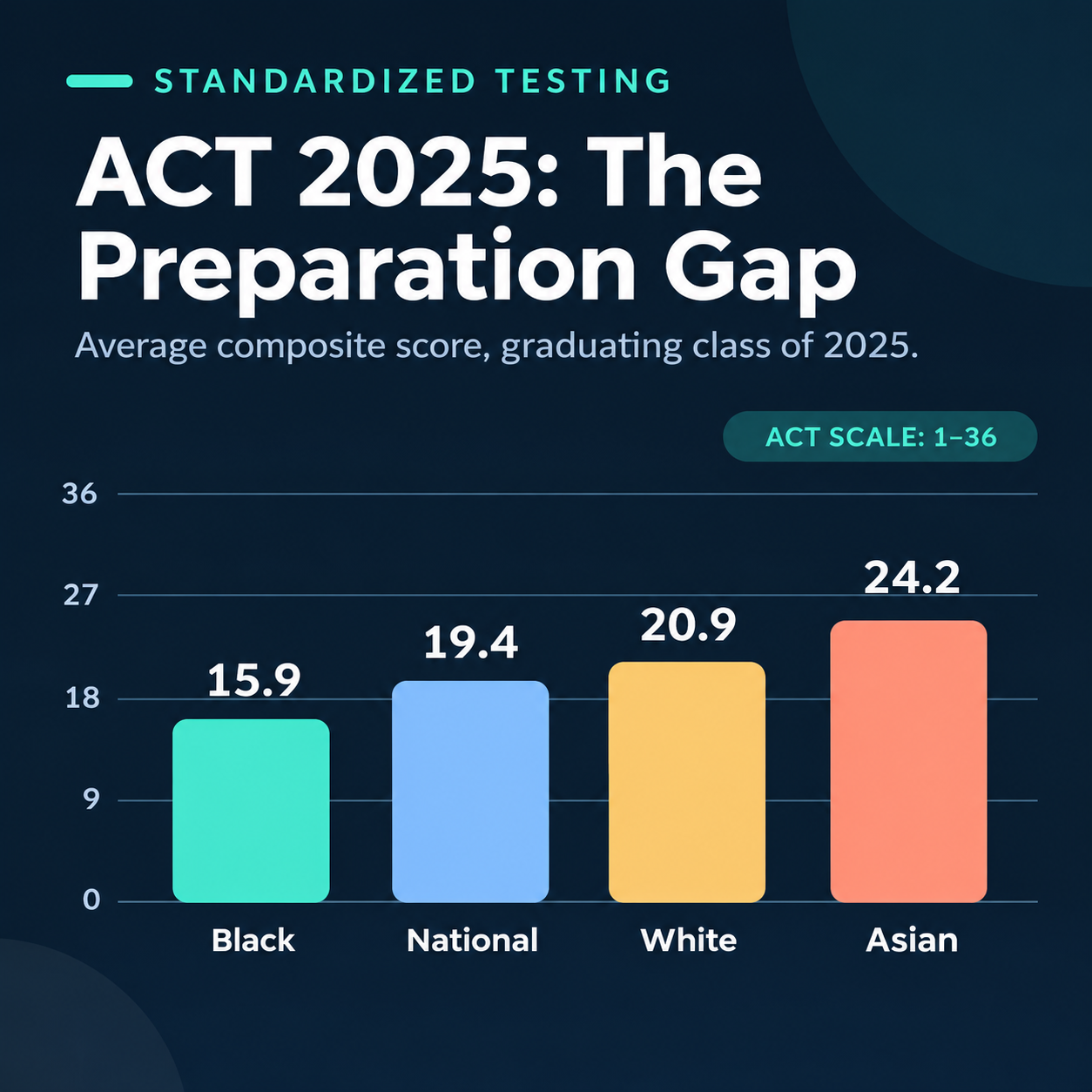
More than 166,000 Black students in the graduating class of 2025 took the ACT. Their average composite score was 15.9, compared to 19.4 nationally, 20.9 for white students, and 24.2 for Asian students. That gap has held steady for five straight years.
In 2021, Black students averaged 16.3.
College readiness tells an even sharper story
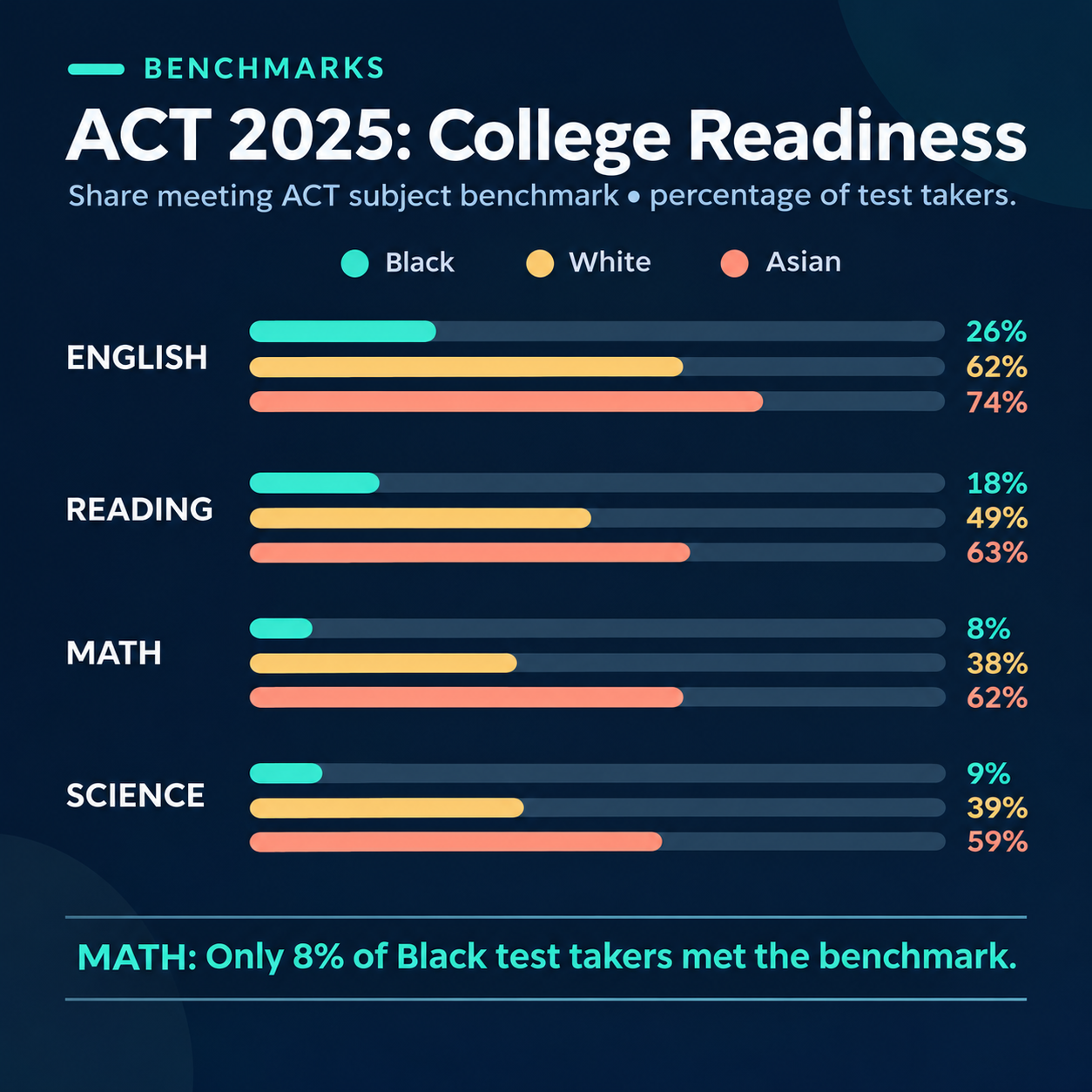
ACT sets benchmarks that signal a strong chance of passing first-year college courses.
In 2025, 26% of Black students met the English benchmark, compared with 62% of White students and 74% of Asian students. In reading, 18% of Black students met the benchmark, compared with 49% of White students and 63% of Asian students. In math, the figures were 8%, 38%, and 62%, respectively. In science, 9% of Black students met the benchmark, compared with 39% of White students and 59% of Asian students.
Fewer than 1 in 10 Black test takers reached the math benchmark. Math is the gateway to engineering, medicine, computer science, and invention.
The access gap hides inside the data
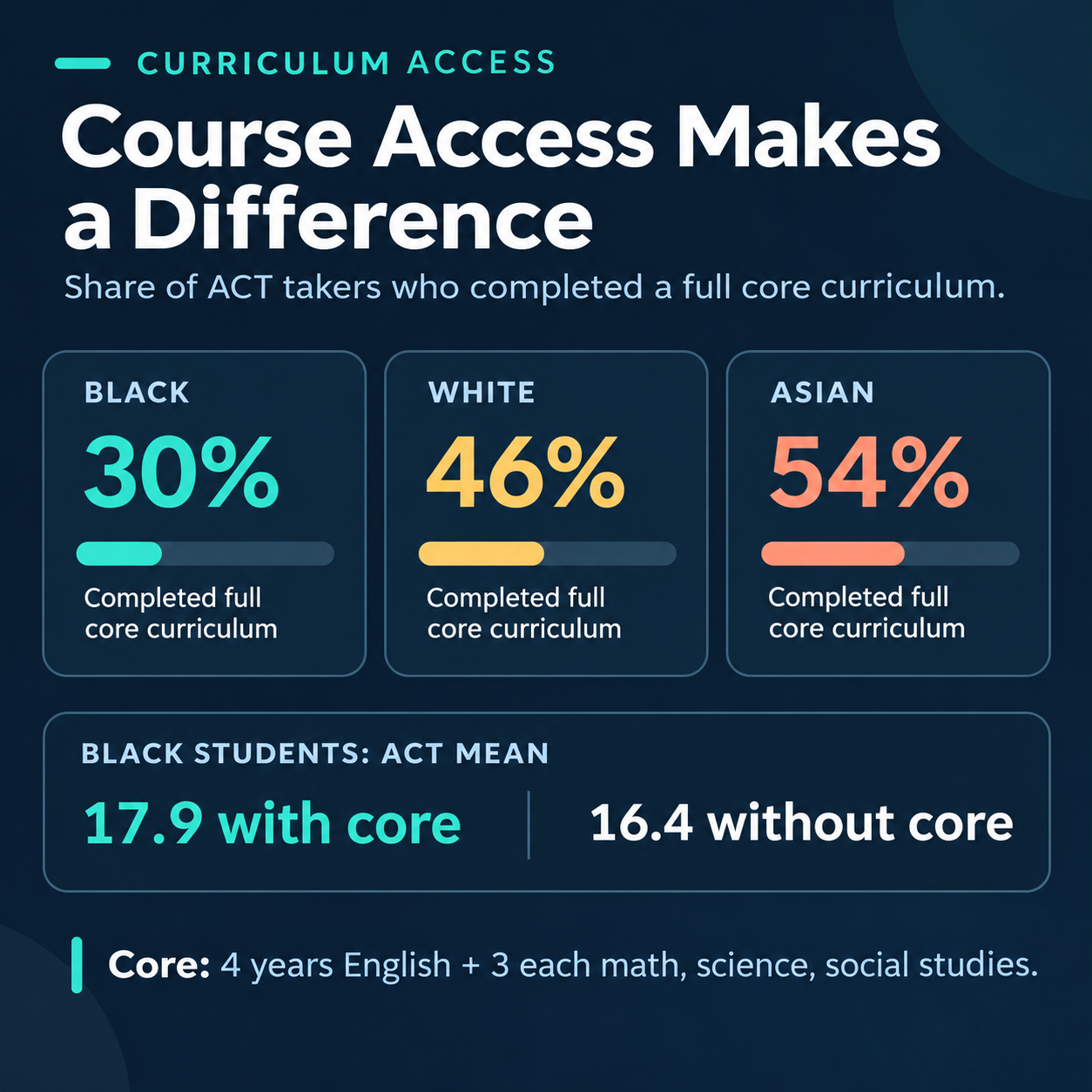
Here is the part every family needs to see. Only 30% of Black ACT takers completed a full core curriculum (four years of English and three years each of math, science, and social studies). Among white students, that figure was 46%. Among Asian students, 54%.
Course rigor changes outcomes. Black students who completed the core curriculum averaged 17.9, compared to 16.4 for those who did not. Among Black students who completed the core, 18% met three or four benchmarks, nearly double the rate of those who did not.
Ambition is not the problem either. Black students who planned on graduate study averaged 20.1 on the ACT, and those aiming for a professional degree averaged 20.2.
Our children dream big. Our systems must prepare them to match those dreams.
The 2025 SAT: The Same Pattern, Sharper Edges
The SAT confirms what the ACT reveals.
About 250,000 African American students in the class of 2025 took the SAT, making up 12.5% of all test takers.
Their results:
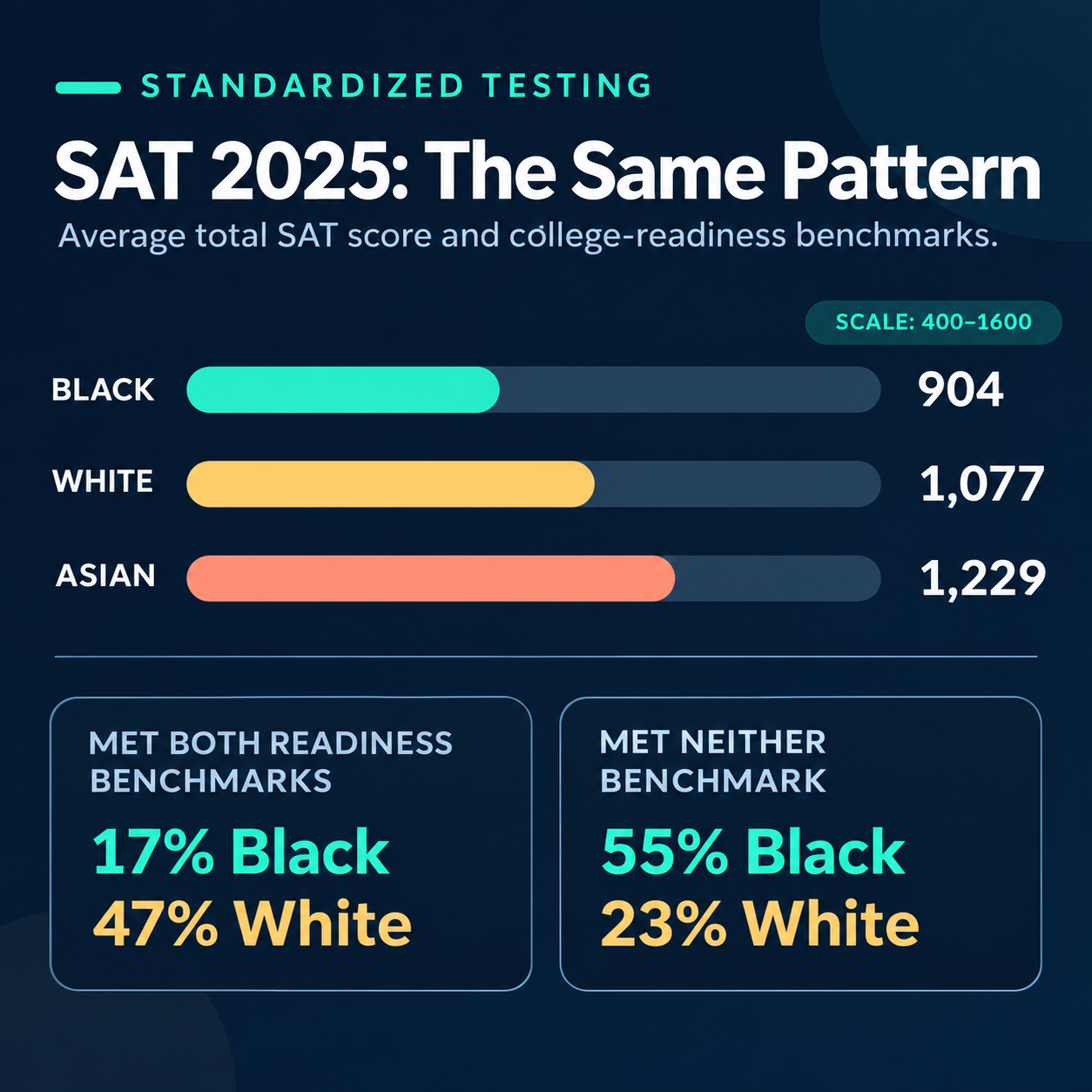
• Average total score: 904, compared to 1,077 for white students and 1,229 for Asian American students
• Reading and Writing: 464, 86 points below white students
• Math: 440, 87 points below white students
• Only 17% met the college readiness benchmark in both reading and math, compared to 47% of white students
• 55% met neither benchmark, compared to 23% of white students
• White students were seven times as likely as Black students to score between 1400 and 1600, the range most selective colleges expect
Since the 2023 Supreme Court decision ending race-conscious admissions, these scores carry more weight than ever at selective institutions. A test score is a snapshot of the opportunities a student received long before test day.
Right now, that snapshot is costing our children seats, scholarships, and futures.
How ACT and SAT Scores Connect to Income
Test scores and income move together. That link runs in both directions, and it shapes generations.
Income predicts scores
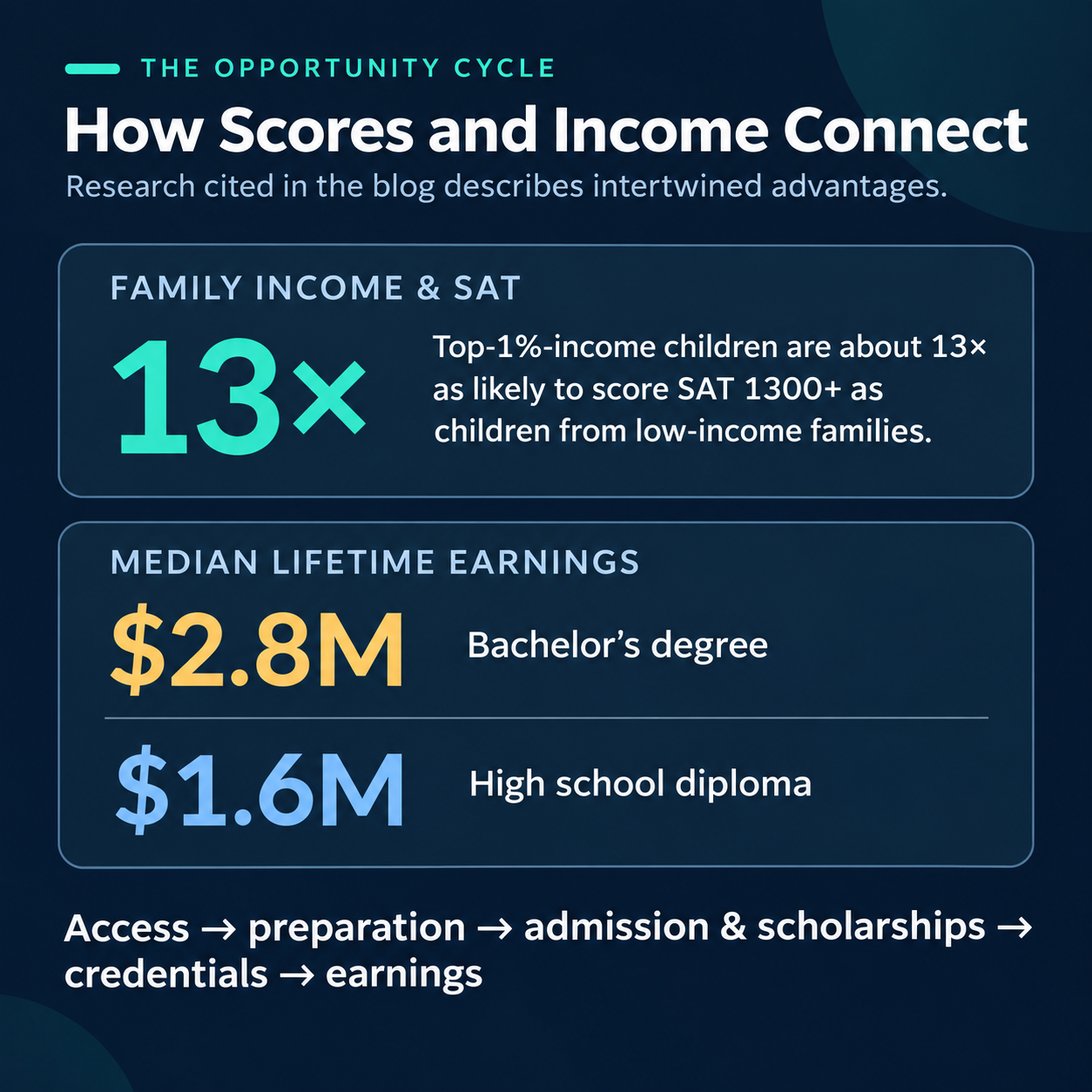
Students from wealthier families score higher at every level. Research led by Harvard economist Raj Chetty found that children from the top 1% of family income are about 13 times more likely to score 1300 or higher on the SAT than children from low-income families. Wealth buys tutoring, test prep, quiet study spaces, and schools with deep course offerings.
Scores predict income
The relationship works in reverse, too. Strong scores open doors to selective colleges, merit scholarships, and high-paying careers. The same research found that test scores predict college success more strongly than high school grades alone.
College completion multiplies the effect.
Bachelor's degree holders earn a median of about $2.8 million over a lifetime, compared to about $1.6 million for workers with only a high school diploma, a difference of roughly $1.2 million.
The cycle we must break
1. Lower family income limits access to test prep and advanced courses.
2. Lower scores limit college admission and scholarship awards.
3. Fewer degrees limit lifetime earnings.
4. Lower earnings limit opportunities for the next generation.
We don't accept this cycle as permanent. Every point gained on the ACT and every 50 points on the SAT can unlock scholarship dollars and new college options. Preparation pays.
The Gap Follows Our Students to Graduate School
The gap does not end at high school graduation. It travels.
The same pattern that appears on the ACT and SAT shows up again on the exams that guard the doors to business, law, and medicine.
The 2024 data proves it.
GMAT: The gateway to business leadership
The GMAT controls access to MBA programs and the executive suite.
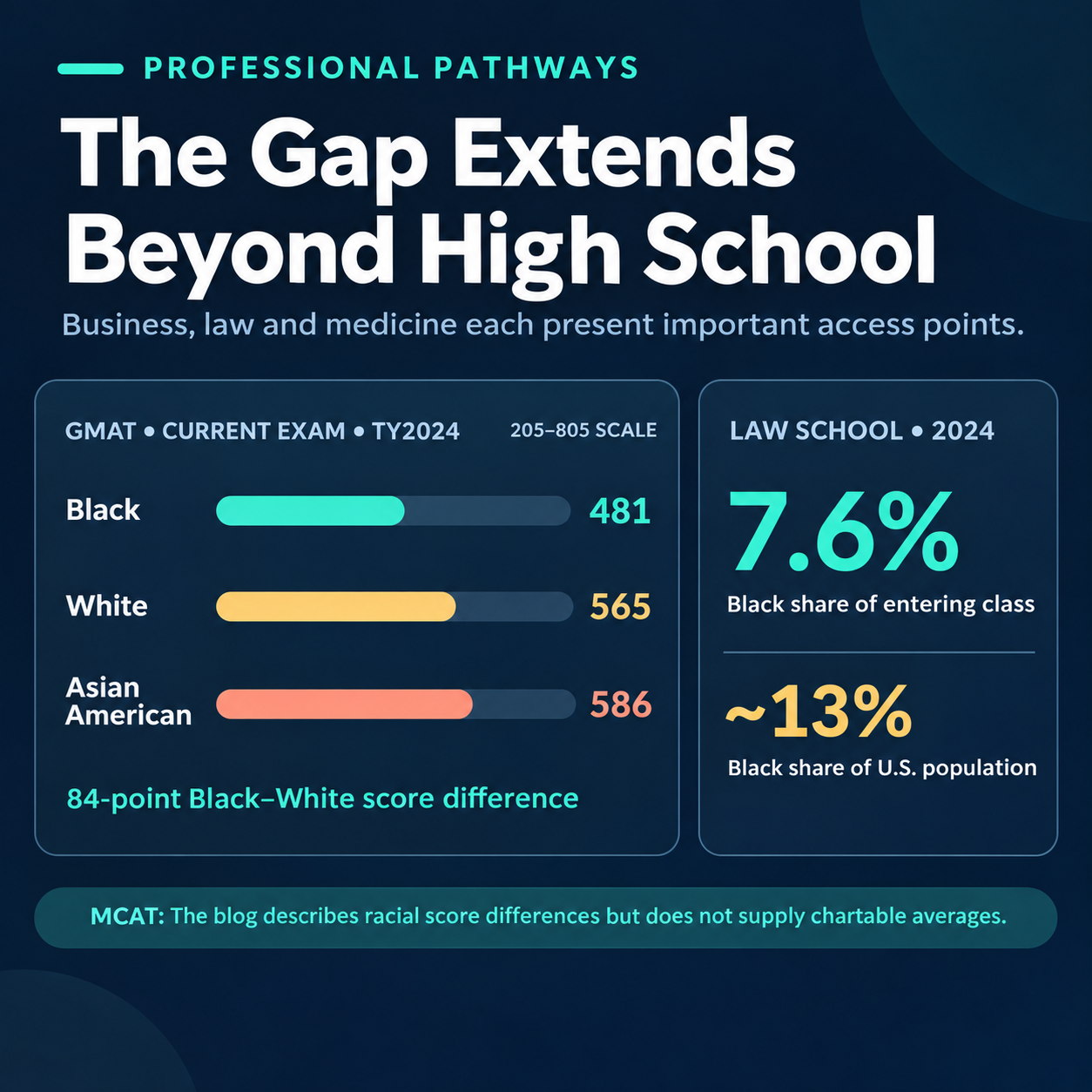
In testing year 2024 (July 2023 through June 2024), GMAC reported these average scores for U.S. citizens on the current GMAT Exam: African American test takers had a mean GMAT score of 481, corresponding to the 19.7th percentile. White test takers had a mean score of 565, corresponding to the 50.9th percentile, while Asian American test takers had a mean score of 586, corresponding to the 60.6th percentile.
That is an 84-point gap between African American and white test takers. On the older 10th Edition exam, still offered during part of that year, African Americans averaged 510, compared to 606 for white test takers and 629 for Asian Americans.
The gap held into testing year 2025, when African Americans averaged 487 and white
test takers averaged 571.
LSAT: The gateway to law and justice
The LSAT remains central to law school admission. In 2024, 98% of all incoming law students used the LSAT in their applications.
Black/African American students made up only 7.6% of the 2024 entering law school class, roughly 3,000 of nearly 39,600 first-year students. That share has slipped from 7.7% in 2023 and 7.9% in 2021. African Americans make up about 13% of the U.S. population.
The communities most affected by the justice system remain the least represented among those trained to shape it.
Participation tells its own story. African American citizens took 1,988 GMAT exams in testing year 2024 (1,113 on the 10th Edition and 875 on the current exam). White citizens took 13,714. Fewer test takers today means fewer Black CEOs, investors, and business owners tomorrow.
MCAT: The gateway to medicine
The MCAT determines who becomes a physician. The Association of American Medical Colleges publishes MCAT scores and GPAs for applicants and matriculants by race and ethnicity in its 2024 FACTS data. Those tables show the same pattern we see from the ACT forward: Black and African American applicants consistently post lower average MCAT scores than White and Asian applicants.
This matters for every family. When fewer Black students become doctors, our communities lose physicians who understand them, live near them, and advocate for them.
What this means: The gap that appears on a third-grade math test becomes the gap on the ACT, then the SAT, then the GMAT, LSAT, and MCAT. The disparity compounds. That is why we must address it at the root.
Patents by Ethnicity: Our Lost Einsteins
Innovation creates wealth. And right now, our communities are locked out of it.
Raj Chetty and his colleagues tracked 1.2 million inventors from birth to adulthood, linking patent records to tax data and childhood test scores.
Their findings are striking:
• White children are about three times as likely to grow up to become inventors as Black children.
• Children from the top 1% of family income patent at a rate of 8.3 per 1,000, far above children from lower-income families.
• Third-grade math scores predict who becomes an inventor. But even among high-scoring children, those from lower-income families invent far less often.
Talent was present. Exposure was missing.
The researchers found that children who grow up around inventors are far more likely to invent themselves, often in the very same field. Mentors and role models make the difference. If women, minorities, and children from low-income families invented at the same rate as high-income white men, America's innovation rate would quadruple.
The researchers called these missing innovators "Lost Einsteins." Their recommendation matches our mission: identify children who excel in math and science early, then surround them with mentoring, internships, and exposure to innovation.
We aren't just preparing students to use technology; we are preparing them to invent it. Bishop Gibert's warning applies directly here. A consumer buys the product. An inventor owns the patent.

How Education Disparities Fuel Wealth and Incarceration Gaps
One disparity feeds the next. Education is the thread that ties them together.
The wealth gap
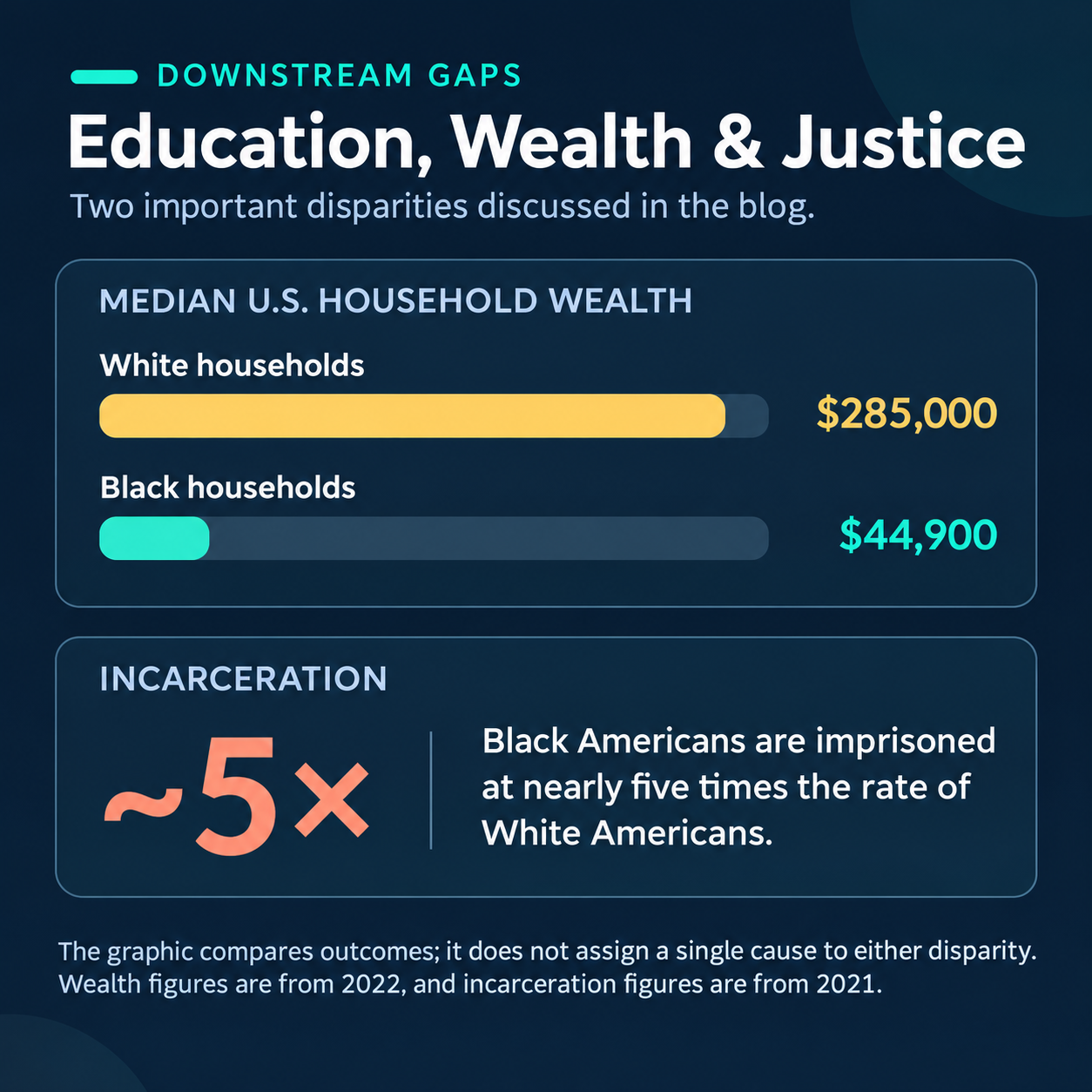
The median white household holds about $285,000 in wealth. The median Black household holds about $44,900.
Education drives this gap through income, homeownership, business creation, and investment knowledge. Higher education leads to higher earnings, and higher earnings lead to savings, property, and wealth passed down through families.
Incarceration
Black Americans are imprisoned at nearly five times the rate of white Americans.
Students who leave school without a diploma face a far higher risk of incarceration. Strong schools, engaged mentors, and clear pathways to college and careers serve as powerful prevention.
What this means: When we close the education gap, we don't fix one problem.
We fix many at once.
What Parents, Grandparents, and Students Can Do Now
The data defines the challenge. Our response defines the future.
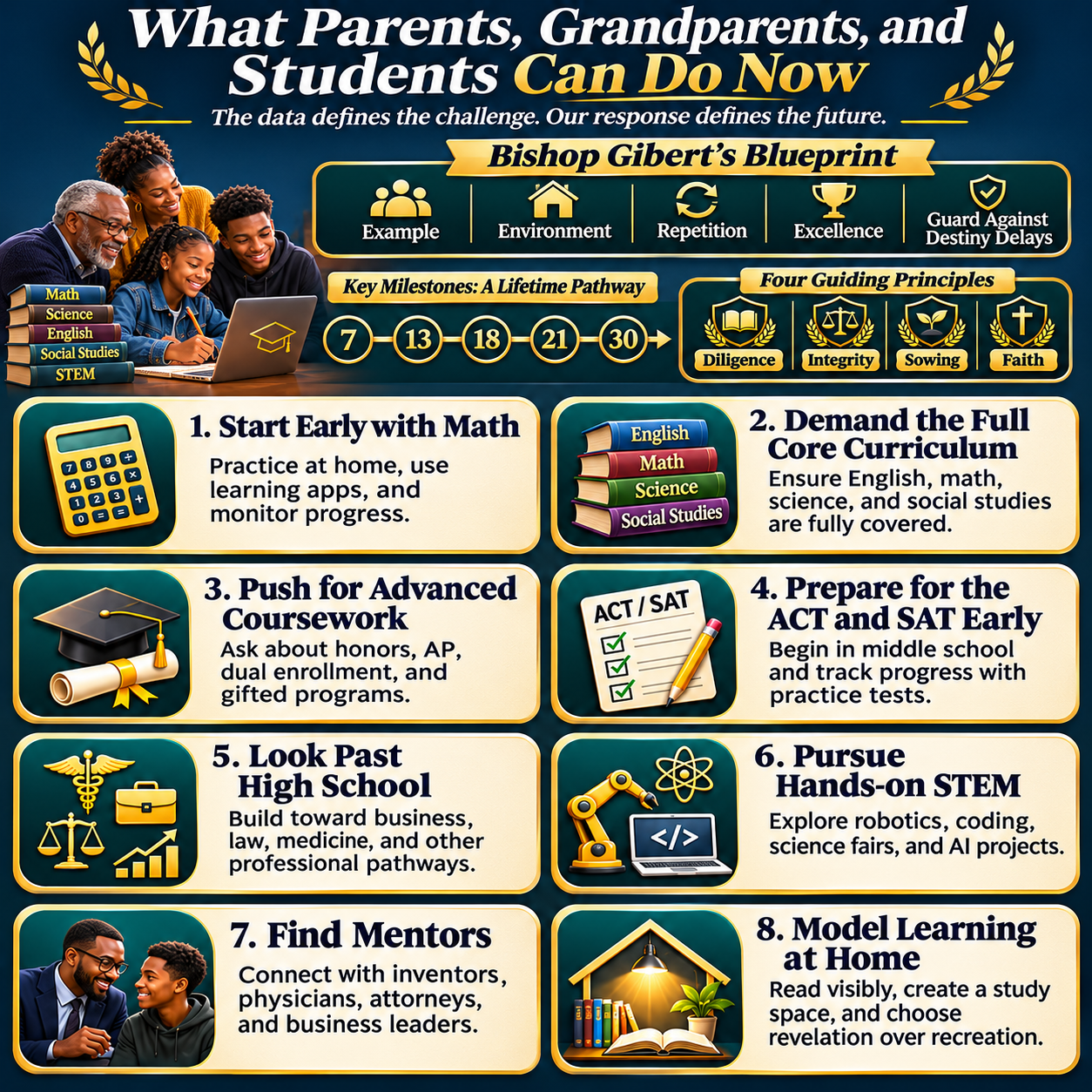
Bishop Gibert gave families a blueprint: lead by example, build the right environment, embrace repetition, expose children to excellence, and guard against "destiny delays" that pull young people off course. He identified key turning points at ages 7, 13, 18, 21, and 30, and four principles that carry a child forward: diligence, integrity, sowing, and faith.
Here is how to put that blueprint to work:
• Start early with math. Third-grade math predicts future innovation. Practice at home, use learning apps, and ask teachers how your child is progressing.
• Demand the full core curriculum. Make sure your child takes four years of English and at least three years each of math, science, and social studies. Push for Algebra I before ninth grade.
• Push for advanced coursework. Ask about honors, AP, dual enrollment, and gifted programs. Don't wait for an invitation.
• Prepare for the ACT and SAT early. Begin practice in middle school. Use free practice tests and track progress.
• Look past high school. Students aiming for business, law, or medicine should know the GMAT, LSAT, and MCAT exist, and start building the reading, reasoning, and science skills those exams demand.
• Pursue hands-on STEM. Robotics, coding clubs, science fairs, and AI projects build skills and confidence.
• Find mentors. Connect your child with inventors, physicians, attorneys, and business leaders who can show them what is possible.
• Model learning at home. Read where your children can see you. Create a dedicated study space. Choose revelation over recreation.
Quick checklist for families
• Review your child's latest math and reading scores
• Confirm your child is on track for a full core curriculum
• Schedule a meeting with a teacher or counselor
• Enroll in at least one STEM enrichment activity
• Take a free ACT or SAT practice test
• Research three scholarships your child can target
• Identify one mentor in a career your child admires

The Future We Are Building Together
Education is the root disparity, and that makes it our greatest opportunity.
The 2025 ACT and SAT gaps, the 2024 GMAT, LSAT, and MCAT gaps, and the patent gap are not verdicts on our children's ability. They are evidence of unequal access.
And access is something we can change.
Bishop Gibert's charge rings true: educate first, or risk raising a generation trained only to be slaves, servants, or consumers.
We choose a different outcome. We choose to raise engineers, physicians, attorneys, founders, and inventors.
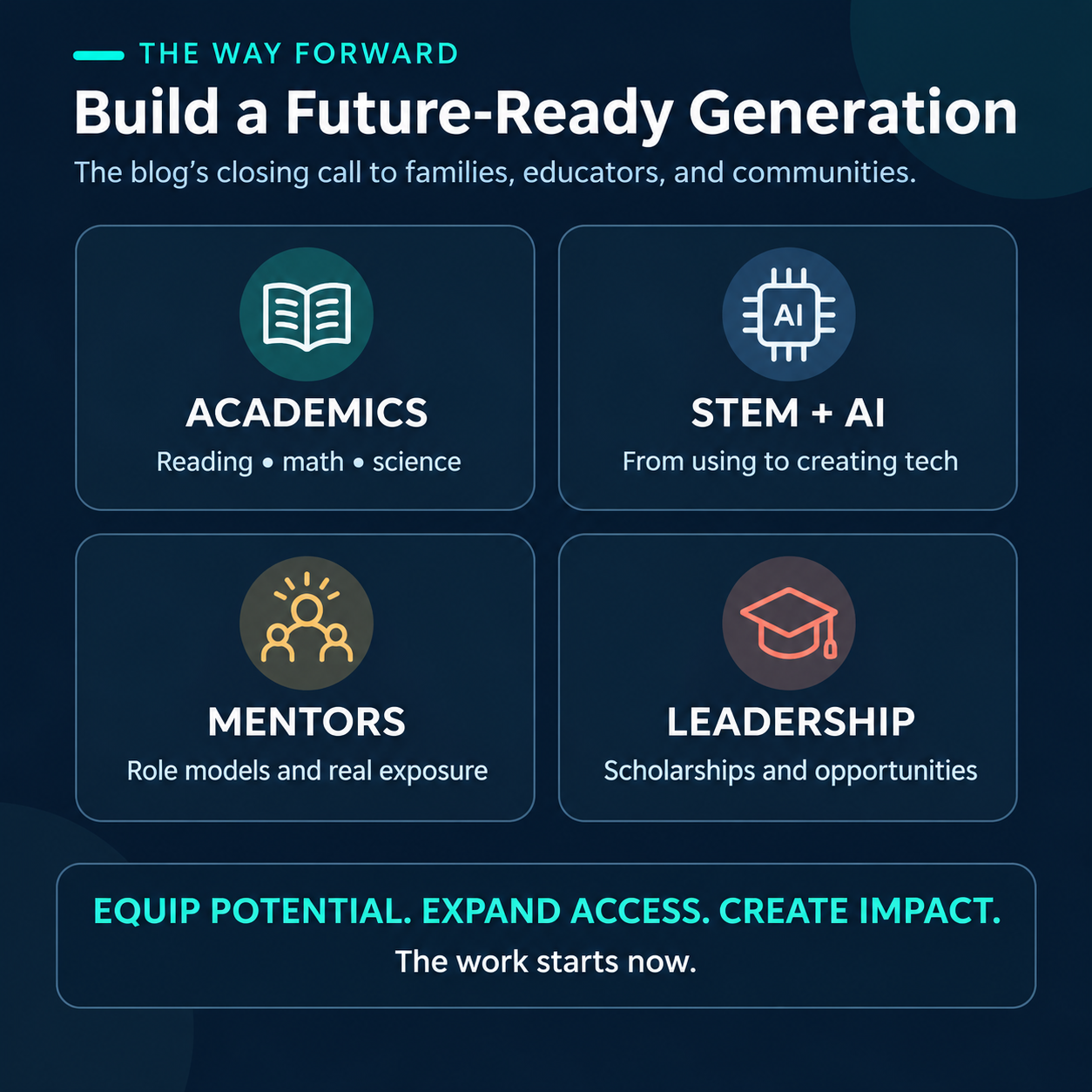
When we equip students with rigorous academics, hands-on STEM experience, AI fluency, and a village of parents, grandparents, mentors, and educators who refuse to settle, there is no limit to what they can achieve.
The work starts now. Connect with t.Lab to learn how our AI-integrated curriculum, test preparation, leadership development, and scholarship support can unlock your child's potential. Together, we will close the gap at its source and build a future-ready generation of leaders.
Meet the Author
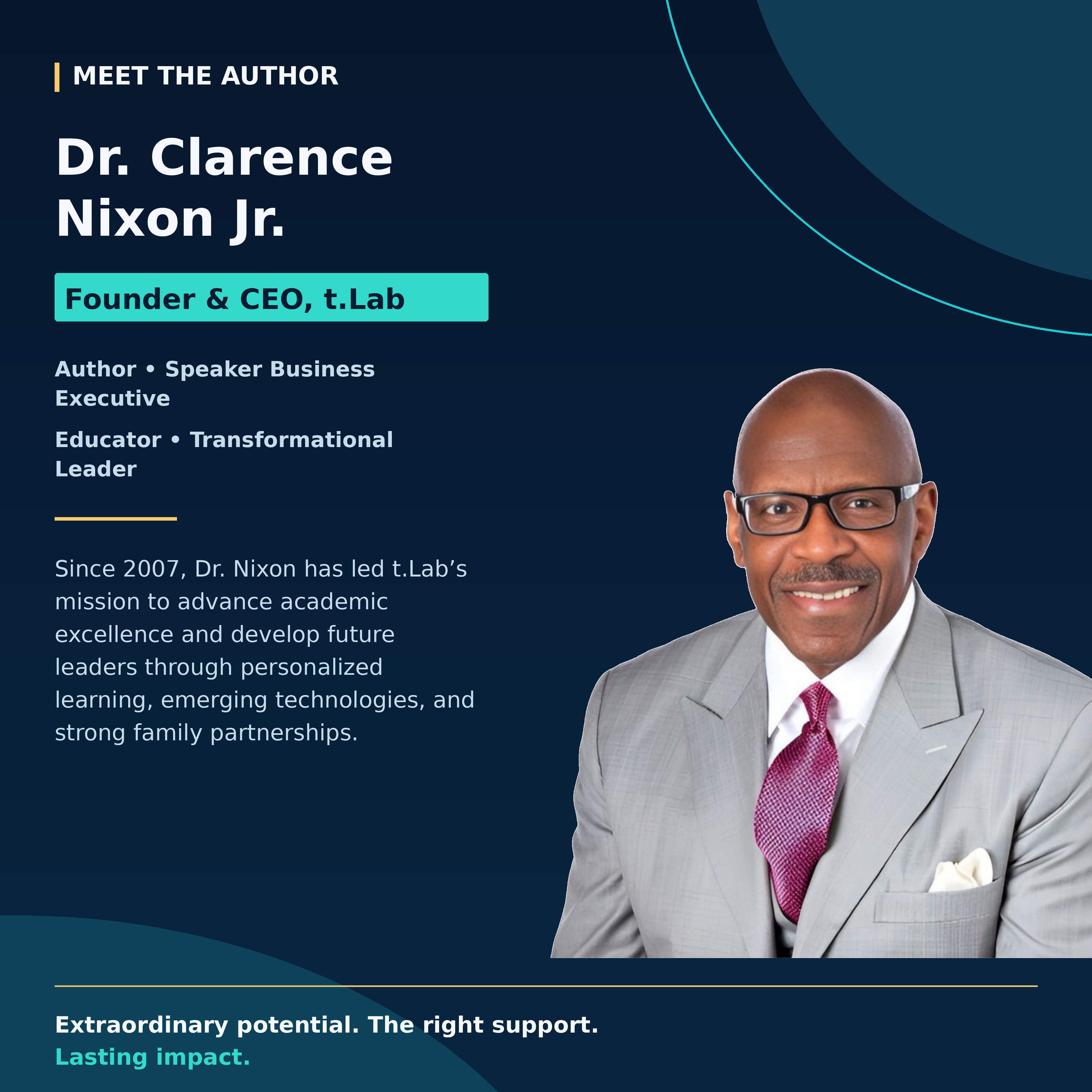
Dr. Clarence Nixon, Jr.
Founder & CEO, t.Lab
Dr. Clarence Nixon, Jr. is an author, speaker, business executive, educator, and transformational leader. Since 2007, he has led t.Lab’s mission to advance academic excellence and develop future leaders through personalized learning, emerging technologies, and strong family partnerships.
In this blog, he examines educational disparities and the steps families can take to expand access to rigorous academics, STEM opportunities, and preparation for college and careers.
Notes and Sources
Footnotes
1. Bishop B.A. Gibert, Educating Our Children in the 21st Century, inaugural episode, t.Lab Global TV and Radio podcast.
2. ACT, Inc., The ACT Profile Report – National, Graduating Class 2025 (Tables 1.5, 2.2, 2.3, 3.3, 4.2; Figures 2.1, 3.1, 4.1).
3. The Journal of Blacks in Higher Education, "The Racial Gap in Scores on the SAT College Entrance Examination," October 13, 2025, reporting data from the College Board's 2025 SAT Suite of Assessments Annual Report.
4. Raj Chetty, David J. Deming, and John N. Friedman, "Diversifying Society's Leaders? The Determinants and Causal Effects of Admission to Highly Selective Private Colleges," NBER Working Paper 31492, Opportunity Insights, 2023.
5. Georgetown University Center on Education and the Workforce, The College Payoff: More Education Doesn't Always Mean More Earnings, 2021.
6. Graduate Management Admission Council (GMAC), Profile of GMAT Testing: North America, Five-Year Summary, TY2021–TY2025, October 2025, Table 3: GMAT Testing Trends by Race/Ethnicity (U.S. Citizens Only). Testing year 2024 ran July 1, 2023, through June 30, 2024. Scores on the 10th Edition and current GMAT Exam use different scales and should not be compared directly.
7. Susan L. Krinsky, "First Impressions of the Incoming Class of 2024: Largest Class Since 2021, Top-Line Diversity Is Level, More Research Needed and the Work Continues," Law School Admission Council (LSAC), December 16, 2024.
8. Association of American Medical Colleges (AAMC), 2024 FACTS: Applicants and Matriculants Data, Table A-18: MCAT Scores and GPAs for Applicants and Matriculants to U.S. Medical Schools by Race/Ethnicity, 2024–2025.
9. Alex Bell, Raj Chetty, Xavier Jaravel, Neviana Petkova, and John Van Reenen, "Who Becomes an Inventor in America? The Importance of Exposure to Innovation," The Quarterly Journal of Economics 134, no. 2 (2019).
10. Raj Chetty et al., "Lost Einsteins: Innovation and Opportunity in America," presentation at the Brookings Institution, December 2017.
11. Board of Governors of the Federal Reserve System, "Changes in U.S. Family Finances from 2019 to 2022: Evidence from the Survey of Consumer Finances," October 2023.
12. The Sentencing Project, The Color of Justice: Racial and Ethnic Disparity in State Prisons, 2021.


